SASSA War Veterans Grant 2026: How Much, Who Qualifies and How to Apply
Published 02 November 2026

The war veterans grant is the monthly grant SASSA pays to a former soldier who fought in the Second World War (1939–1945) or the Korean War (1950–1953) and is unable to support himself. If you served in one of those two wars, are 60 years of age or older or disabled, and pass the means test, you can apply. The grant pays R2 420 per month. Applying is free, and if your application is approved, you will be paid from the day you applied. This guide covers how much it pays in 2026, who qualifies, the means test figures, the documents to bring, and how to apply.
How Much Is the War Veterans Grant in 2026?
The war veterans grant pays R2 420 per month — the amount published on the official gov.za service page for this grant. Grant amounts are increased from time to time by government announcement, so confirm the latest amount on official SASSA channels before relying on this figure.
Do not confuse this grant with the grant for older persons. They are separate grants with separate rules — and you cannot receive both at the same time. The war veterans grant exists for one specific reason: your war service.
Who Qualifies?
To get a war veterans grant, you must:
- Be a South African citizen or permanent resident.
- Live in South Africa.
- Be 60 years of age or older or be disabled.
- Have fought in the Second World War or the Korean War.
- Not receive any other social grant for yourself.
- Not be cared for in a state institution.
- Not earn more than R 112 200 a year if you are single, or R224 400 if you are married.
- Not have assets worth more than R 1 584 000 if you are single, or R 3 168 000 if you are married.
Every rule on that list must be met. The two that decide most applications — war service and the means test — get their own sections below.
Two Wars Only: The Service Rule
This grant's defining rule is the service itself. The official definition is a former soldier who fought in the Second World War (1939–1945) or the Korean War (1950–1953) and is unable to support himself. No other service opens the door: if your service falls outside those two wars, this is not your grant.
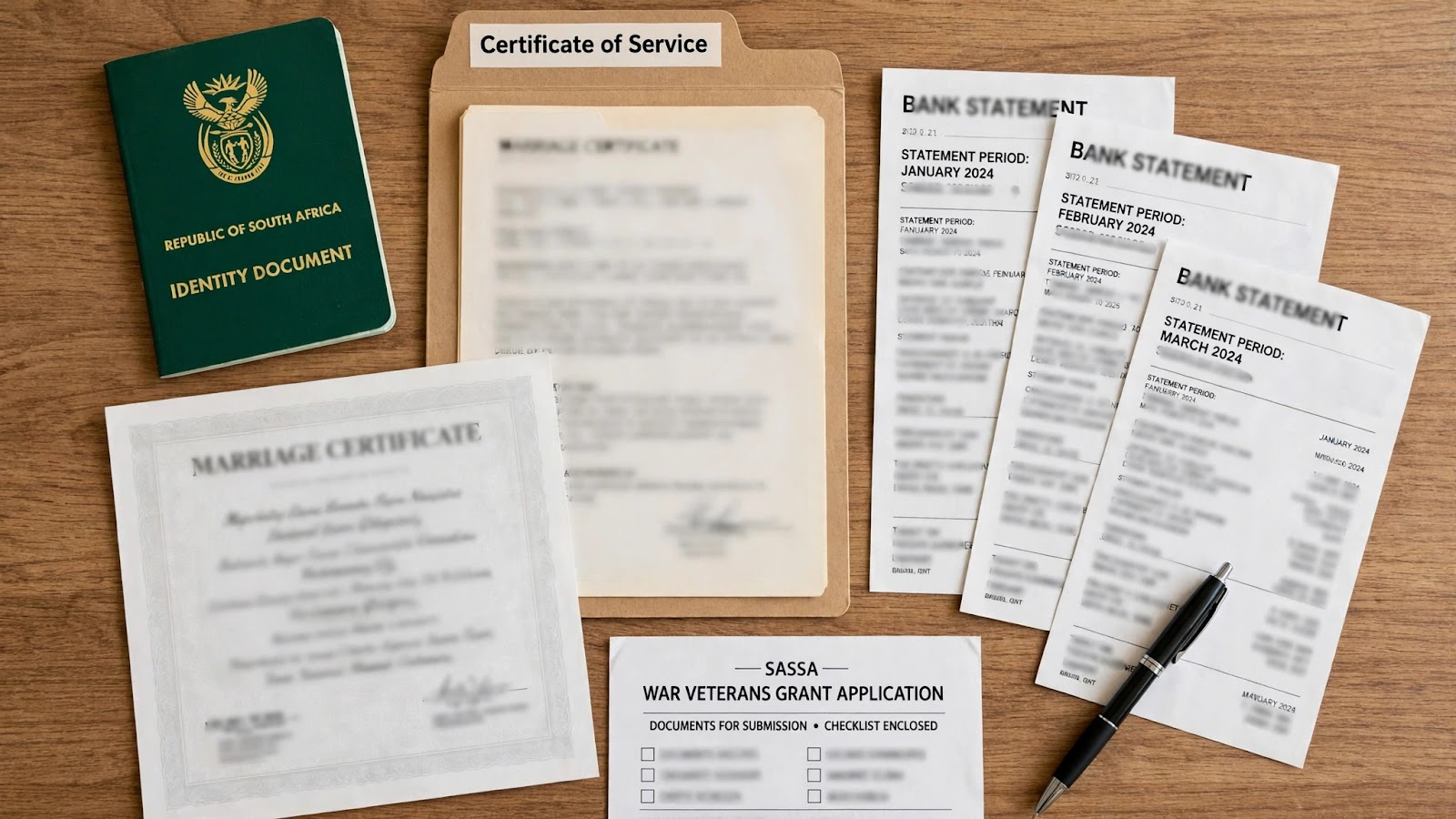
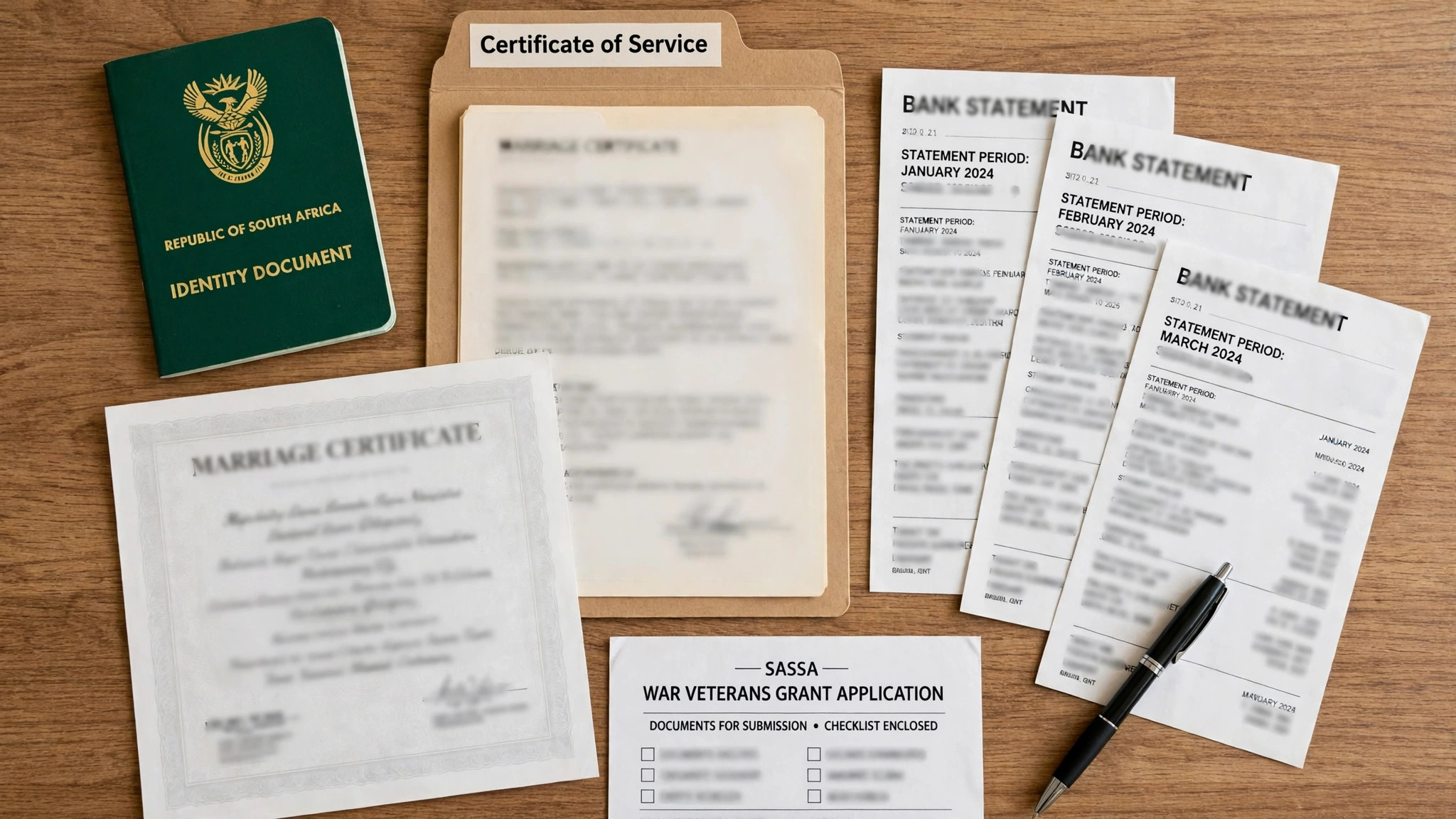
Your proof is documentary: among the documents you must bring is proof of your war service, e.g. a certificate of service. If you are under 60 and applying on the disability leg of the rules, you must also bring a medical assessment or report stating that you cannot work.
The Means Test
The war veterans grant is means-tested, and the official page publishes the exact figures. You must:
- Not earn more than R 112 200 a year if you are single, or R224 400 a year if you are married.
- Not have assets worth more than R 1 584 000 if you are single, or R 3 168 000 if you are married.
One important exception is printed on the official page: if you live in the house that you or your spouse own, its value is not taken into account for the purpose of the means test. Your home does not count against the asset limit.
The means test is also why the documents list below asks for so much financial paper — pay slips, three months of bank statements, and investment income information. Bring the proof with you rather than expecting a second trip.
Not sure whether your own income and assets fall inside these limits? Run your numbers in our SASSA Means Test Checker - it uses the same 2026/27 thresholds explained above.
You Cannot Hold Another Social Grant — With One Add-On Exception
The official rules state it plainly: to qualify, you must not receive any other social grant for yourself. A veteran who already receives the grant for older persons cannot add the war veterans grant on top of it — the grants are alternatives, not layers.
There is one deliberate exception. The grant-in-aid is an additional grant designed to attach to a main grant — and the war veteran's grant is one of the three main grants it attaches to. If you receive the war veterans grant and, owing to a physical or mental disability, you cannot look after yourself and need full-time care, the grant-in-aid pays an extra amount on top to help pay the person who cares for you.
If You Are Admitted to an Institution: The 25% Rule
One qualifying rule says you must not be cared for in a state institution — but the official page also covers what happens if your circumstances change after approval. If you are admitted to an institution that has a contract with the state to care for you, your grant is reduced to 25% of the maximum amount of the grant. The reduction starts from the fourth month following your admission, and the reduced grant is reinstated immediately from the date you are discharged. Admission to a state institution is also a lapse event (listed below) — tell SASSA about any admission.
Documents You Need
Take the following to the SASSA office when you apply:
- Your 13-digit bar-coded identity document (ID).
- Proof of your war service, e.g. a certificate of service — the decisive document for this grant.
- If you are under 60: a medical assessment or report stating that you cannot work.
- Proof of your marital status: if you are single, an affidavit stating that you are single; if you are married, your marriage certificate and your spouse's identity document; if you are divorced, your divorce order; if your spouse is dead, your spouse's death certificate.
- If you or your spouse is employed: your pay slips.
- If you are unemployed: your Unemployment Insurance Fund (UIF) blue book or discharge certificate from your previous employer.
- If you have a bank account: your bank statements for the last three months.
- If you have investments: information on the interest and dividends you earn.
If you do not have an ID: complete an affidavit on a standard SASSA format in the presence of a Commissioner of Oaths who is not a SASSA official, and bring a sworn statement signed by a reputable person — such as a councillor, traditional leader, social worker, minister of religion or school principal — who can verify your name and age, plus proof that you have applied for an ID at the Department of Home Affairs and a temporary ID, if applicable.
If you are too old or sick to travel to the office to apply: a family member or friend can apply on your behalf. That person should take a letter from you and/or a doctor's note saying why you cannot visit the office.
How to Apply Step by Step
The application is made in person at a SASSA office — application forms are not available online, but you can get them from your nearest SASSA office. The process works like this:
- Go to the SASSA office nearest to where you live, with all the documents listed above.
- Complete the application form in the presence of the SASSA officer. Only you as the applicant, or a SASSA official, may complete the application form.
- Keep the receipt you are given — it is your proof that you applied.
- If you want to enrol for cash payments, the SASSA officer will give you a date when you need to come back and what you need to bring with you.
- Wait for the outcome. It may take up to three months to process your application.
If your application is approved, you will be paid from the day you applied. The service is free. Nobody may charge you a fee to apply — if someone asks for payment, walk away and go directly to a SASSA office.
How and When You Will Be Paid
SASSA pays the grant to you through one of the following methods:
- Cash at a specific pay point on a particular day.
- Electronic deposit into your bank or Postbank account. (Your bank may charge you for the service.)
- An institution acting as administrator of the grant, such as a welfare organisation.
If you are unable to collect the money yourself, you can appoint a procurator at the SASSA office, or give someone power of attorney to collect the grant on your behalf.
As for dates: SASSA pays grants in a set order each month — older persons grants first, then disability grants, then children's grants — and the war veterans grant is paid with the first group. Exact dates are announced ahead of each month — check the announcement or our SASSA payment dates guide rather than relying on last month's dates. There is no need to rush to withdraw on the first day — money in your account stays there.

Reviews, Suspension and When the Grant Lapses

SASSA can decide if your grant must be reviewed — your income as declared when you apply forms the basis of this decision. You will be notified three months in advance of the review date, or of the date on which the life certificate (a document to prove that you are still alive) is due. If you receive your money through the bank, an institution or a procurator, you must fill in a life certificate at the SASSA offices every year.
Your grant may be suspended:
- When your circumstances change.
- As the outcome of a review.
- If you fail to co-operate when your grant is reviewed.
- When you commit fraud or misrepresent yourself.
- If there was a mistake when your grant was approved.
Your grant will lapse in the case of:
- Death.
- Admission to a state institution.
- The grant not being claimed for three consecutive months.
- When you are absent from the country.
Why Applications Are Declined — and How to Appeal
Most unsuccessful applications fail on the basic rules above:
- Wrong war: your service was not in the Second World War or the Korean War, however genuine the service was.
- Another social grant: you already receive another social grant for yourself, such as the grant for older persons.
- Means test: your income or assets are above the limits — R 112 200 / R224 400 a year in income, R 1 584 000 / R 3 168 000 in assets, single or married.
- No proof of service: you cannot produce proof of your war service, such as a certificate of service.
- Under 60 without medical proof: you are under 60 and have no medical assessment or report stating that you cannot work.
- State institution: you are cared for in a state institution.
If your application is not approved, SASSA will inform you in writing why. Read that letter carefully — it tells you which rule you failed, and sometimes the problem is a fixable document issue. Also read our guide on why SASSA grants are declined and how to fix it.
If you disagree with the decision, you can appeal to the Minister of Social Development at the national office of the Department of Social Development. The appeal must be lodged within 90 days of being notified that your application was unsuccessful — do not let that deadline pass.
Frequently Asked Questions
1. How much is the war veterans grant per month in 2026?
R2 420 per month, according to the official gov.za service page for this grant.
2. Which wars count for the war veterans grant?
Only two: the Second World War (1939–1945) and the Korean War (1950–1953). You must have fought in one of them, and you must bring proof of your war service, such as a certificate of service.
3. Can I get the war veterans grant and the older persons grant together?
No. The official rules require that you not receive any other social grant for yourself. The one add-on that can be paid on top of a war veterans grant is the grant-in-aid, if you need full-time care because of a physical or mental disability.
4. What are the means test limits?
You must not earn more than R 112 200 a year if you are single or R224 400 if you are married, and not have assets worth more than R 1 584 000 if you are single or R 3 168 000 if you are married. The value of the house you or your spouse own and live in is not taken into account.
5. I am under 60. Can I still qualify?
Yes, on the disability leg of the rules: you must be 60 years of age or older or be disabled. If you are under 60, bring a medical assessment or report stating that you cannot work, together with your proof of war service.
6. What happens to my grant if I move into a care institution?
If the institution has a contract with the state to care for you, your grant is reduced to 25% of the maximum amount, starting from the fourth month after your admission, and it is reinstated immediately when you are discharged. Admission to a state institution is a lapse event, so inform SASSA of any admission.
7. How long does it take, and from when am I paid?
Processing may take up to three months. If approved, you are paid from the day you applied. Applying is free — keep your receipt as proof.
Conclusion
The war veterans grant — R2 420 a month — supports the former soldier who fought in the Second World War or the Korean War and can no longer support himself: a citizen or permanent resident, living in South Africa, 60 or older or disabled, inside the means test, holding no other social grant for himself. Take your ID, your proof of war service and your financial documents to your nearest SASSA office, keep your receipt, and remember that approval pays you from the day you applied. With this guide, every SASSA grant now has a dedicated guide on this blog — see our complete index of SASSA grants and SRD guides for how they all fit together.
Disclaimer: Payment dates and amounts change — always confirm on the official site sassa.gov.za.
Related SASSA Guides